
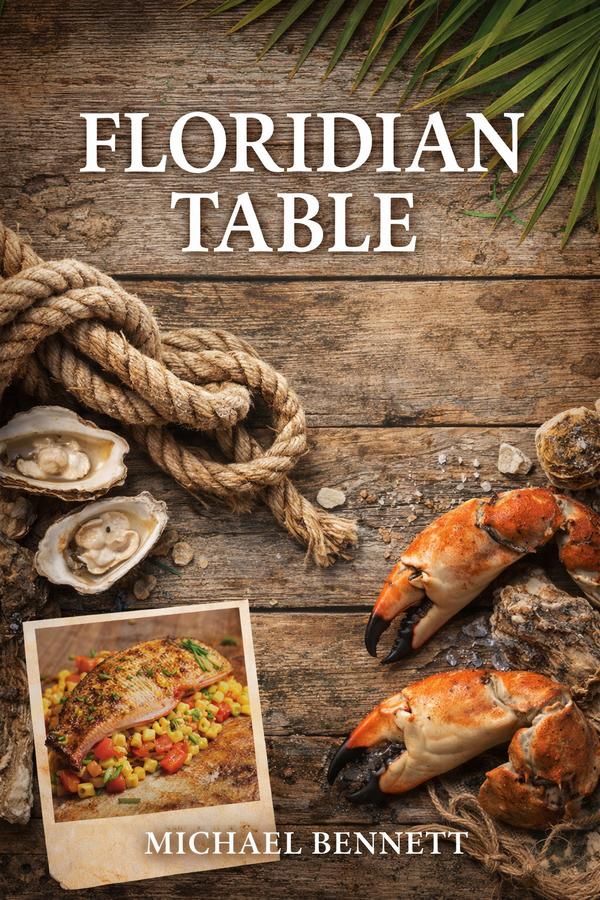
Chef Bennett’s new book “The Floridian Table” Teachs a Framework that Reframes Subtropical Cooking as a Philosophically Coherent Culinary Discipline.
MIAMI, FL, June 02, 2026 /24-7PressRelease/ — A comprehensive culinary teaching framework developed by Chef Bennett is redefining how Florida cuisine is understood, taught, and practiced in professional kitchens. “The Floridian Table: A Theoretical Response & Teaching Guide” argues that Florida’s culinary identity is not a trend, a fusion experiment, or a collection of tropical recipes — but an environmentally determined, culturally layered culinary system with its own philosophy, technique, and logic.
The curriculum, designed for advanced culinary students and professional instructors, spans six comprehensive modules and introduces four core principles that together form what the framework calls a “culinary constitution” for Florida cooking: balance over richness, freshness over manipulation, environment over tradition alone, and system over individual recipes.
“Florida cuisine is not invented — it is accumulated. Its subtropical climate, its cultural history, and its proximity to the ocean on three sides create a culinary system unlike any other American region.”
— Chef Bennett,
The Floridian Table
A Six-Module Curriculum Built Around Florida’s Environment and Culture
The Floridian Table curriculum challenges culinary educators to simultaneously honor classical European foundations while dismantling the assumption that those foundations are universal. Each of its six modules addresses a distinct pillar of Florida’s culinary identity.
Theory 1: Regional Framework & Culinary Identity establishes Florida’s culinary identity through the lens of environmental logic, cultural memory, and technical vocabulary, tracing ingredient corridors from Andalusia, Cuba, Haiti, the Yucatán, and the American Deep South.
Theory 2: Warm-Water Seafood Systems forms the technical core of the curriculum, examining the biological differences between warm- and cold-water species — grouper, snapper, mahi-mahi, pompano, cobia, and others — and the species-specific fabrication and heat management required by each.
Theory 3: Acid-Driven Sauce Architecture directly challenges classical French sauce doctrine by replacing fat as the primary structural agent with Florida’s native acids: key lime, sour orange, tamarind, passion fruit, and fermented hot sauces. Students learn acid as architecture, not seasoning.
Theory 4: Tropical Product Management addresses the highest-variability ingredients in the Florida pantry — plantains, papaya, mango, hearts of palm, calabaza — teaching students to read ripeness, manage enzymatic activity, and balance high natural sugar content against acid and salt.
Theory 5: Cross-Cultural Culinary Integration draws a rigorous distinction between fusion and integration — requiring students to understand the structural logic of Seminole, Cuban, Haitian, Bahamian, Caribbean, and Southern Appalachian culinary traditions before synthesizing them into a single, coherent dish.
Theory 6: Dock-to-Plate Sourcing Models moves the curriculum into operational reality, teaching students to design menus as frameworks of technique rather than fixed lists of dishes — enabling fluid species substitution and real-time sourcing decisions grounded in both sustainability and financial accountability.
Four Principles
At the heart of the curriculum are four philosophical principles intended to be taught not merely as summary points, but as a unified culinary framework:
Balance over Richness: Satisfaction in a dish does not require fat saturation. A well-balanced acid-forward preparation can be deeply satisfying without added richness.
Freshness over Manipulation: Restraint is a skill. The highest expression of a perfect local fish may be impeccable seasoning, precise heat, and a single acid element.
Environment over Tradition Alone: Classical training provides essential tools, but those tools were built for specific environments. Understanding why traditions developed allows cooks to adapt them intelligently rather than apply them blindly.
System over Individual Recipes: A systems thinker can walk into an unfamiliar market, identify available proteins, acids, and aromatics, and construct a coherent plate a curriculum aims to develop.
A Model for Regional Cuisine Education Worldwide
The Floridian Table makes a larger claim beyond Florida itself. Its methodology — map the environment, identify cultural convergences, build a technical vocabulary around local proteins and acids, design a system rather than a recipe list — is presented as a universal model for understanding how any regional cuisine develops and should be taught.
A culinary student in the Pacific Northwest, the Yucatán, or coastal West Africa applying this same methodology would arrive at a coherent, teachable, and authentic regional cuisine. That ambition is named explicitly in the curriculum’s closing notes, positioning The Floridian Table not as a regional subject but as a discipline of regional thinking.
The capstone assignment requires students to present a composed dish verbally — covering sourcing rationale, technical decisions, flavor logic, and cultural reference — reflecting the curriculum’s conviction that the ability to articulate culinary thinking is itself a professional skill, and that the best dishes are made by cooks who can explain why every element is on the plate.
About Chef Bennett
The author is a seasoned culinary professional who believes that the essence of great cooking is clarity and context.
The chef Bennett’s philosophy is that good food should never feel inaccessible. By demystifying intricate techniques and emphasizing the logic behind them, they empower cooks to confidently expand their skills without feeling overwhelmed.
To cook in Florida, is where the kitchen is always a classroom and every meal is an opportunity to learn.
—
For the original version of this press release, please visit 24-7PressRelease.com here
Legal Disclaimer: This article was provided by an independent third-party content provider. Kyrion Media makes no warranties or representations in connection with it. All information is provided “as is” without warranty of any kind. This content may not have been reviewed by our editorial staff and is published automatically. The views expressed in this article are those of the author and do not necessarily reflect the views of Kyrion Media. All trademarks are the property of their respective owners. If you are affiliated with this article and would like it removed, please contact retract@kyrionmedia.com.