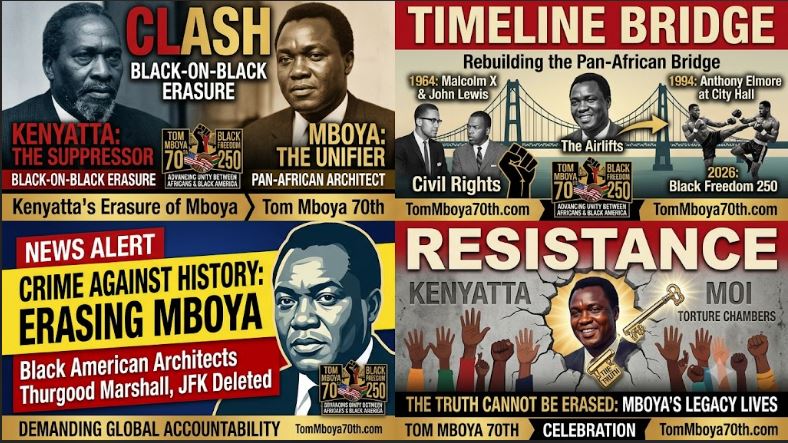
Tom Mboya 70th Celebration charge Kenya with erasing Tom Mboya, Thurgood Marshall, and the Black American architects of Kenya’s birth—demanding global accountability through Black Freedom 250th and Tom Mboya 70th: Event fights Black on Black Racism
MEMPHIS, TN, August 10, 2026 /24-7PressRelease/ – Please click here to read the essence of this dossier titled: THE ORANGE MOUND MANIFESTO: RECLAIMING THE UNBROKEN BRIDGE.
This dossier must be covered via the “Black American Press.” Unknown and untold in America is the fact that Kenya President Jomo Kenyatta used his function and authority to created a brutal authoritarian regime whereas he murdered anyone who stood in his way of power.
Noted on record is Barack Obama Sr. the father of our beloved 1st Black President Barack Obama Jr. accused Jomo Kenyatta of killing Kenyan liberationist Tom Mboya July 5, 1969. Because Barack Obama Jr. spoke out Jomo Kenyatta took his passport, Blacklisted him and drove Barack Obama Sr. to his death.
Click here to see the video titled: “The Kisumu massacre of 1969 Citizens in Kisumu County in Western Kenya complained about the death of Tom Mboya. In the end Jomo Kenyatta’s police force killed many unarmed citizens, banded political opposition and looted the nations wealth. Just to give you a figure Jomo Kenyatta and his family acquired 500,000 acres of prime land in Kenya. To put 500,000 acres into perspective, it helps to convert it into square miles: 500,000 acres equals approximately 781 square miles. The history in Kenya is that anyone who complains were put to death whereas in 2026 there is silence in Kenya whereas there needs to be America reporters who can tell about the corruption in Kenya.
President Barack Obama threaten to cancel the visas of various Kenyan leaders unless reforms were made. President Obama’s own brother betray him. Click here to view our video titled: Anthony “Amp” Elmore: Why President Obama did not Visit Siaya County in Kenya. Anthony “Amp” Elmore visited Western Kenya meeting 5 Governors. Siaya County Governor Cornell Rasanga and the entire legislative body came to Memphis to arrange a “Crooked Deal.” This happen in 2013. Things were so bad that President Obama when we visited Kenya as President could not visit Siaya County the home of his Kenyan Family. Four year later President Obama’s half brother betrayed him and supported Donald Trump.
A coalition of Black American activists, historians, and civil rights advocates announced today a formal campaign to charge the Kenyan government with historical betrayal and systemic erasure regarding the foundational role Black America played in Kenya’s journey to independence.
Timed alongside the upcoming Black Freedom 250th and the Tom Mboya 70th Celebration, organizers are preparing formal petitions to be delivered to both the United Nations (UN) and the African Union (AU). The petitions demand international accountability for Kenya’s state-level erasure of key historical figures, including U.S. Supreme Court Justice Thurgood Marshall, human rights strategist Tom Mboya, and the African American leaders who financed and championed Kenya’s liberation movement.
The Birth of Kenya as Part of the Civil Rights Movement. The coalition asserts that Kenya’s independence was not achieved in isolation, but was inextricably linked to the American Civil Rights Movement and the erasure denies both Black America and Kenya youth of America’s role in the birth of Kenya. Key figures in America who spearheaded and funded the historic African Airlifts in the late 1950s and early 1960s—including Harry Belafonte, Jackie Robinson, A. Philip Randolph, and President John F. Kennedy—helped build the intellectual and political foundation of post-colonial Kenya whereas Kenya President Jomo Kenyatta after the brutal murder of Tom Mboya in 1969 used his function and authority as Kenya’s President to erase American role in the birth of Kenya.
Most notably, Thurgood Marshall, the legendary civil rights attorney, spent weeks working directly with Kenyan delegates to draft key provisions of Kenya’s first constitution, embedding fundamental human rights into the core fabric of the new republic.
“The historical record is clear”: Kenya’s independence was a shared victory born from the blood, sweat, and political power of Black America,” said the organizers. “Yet, starting under Jomo Kenyatta, the Kenyan government systematically erased America’s role, murdered Tom Mboya, marginalized figures like Barack Obama Sr., and buried this sacred birthright. This erasure is a form of Black-on-Black racism that must be acknowledged and corrected.”
Click here to read the February 1964 issue of the Black Publication of Ebony Magazine
Utilizing primary archives from Time Magazine, JET, and contemporary international press, the campaign directly challenges Kenyan state historians and academic institutions that have sustained this decades-long silence.
The campaign’s central demands include: UN & AU Petitions: Submitting formal documentation to the United Nations and the African Union calling for official inquiries into Kenya’s institutional suppression of Civil Rights history and transnational Black heritage.
Establishment of the Tom Mboya Legacy District in the Orange Mound Black Community in Memphis and demanding the formal recognition and creation of a dedicated historic district in Kenya honoring Tom Mboya and the American architects of Kenyan independence.
Solidarity with Kenya’s Gen Z: Standing firmly with young Kenyans today who are fighting against systemic political corruption, government overreach, and historical revisionism. As the global African Diaspora prepares for the Black Freedom 250th, the coalition insists that true Pan-African unity cannot exist without historical truth.
The Black Freedom 250th & Tom Mboya 70th Campaign is an international civil rights initiative created by Anthony “Amp” Elmore at the African Cultural Embassy in the Historic African/American Orange Mound Community in Memphis. The African Cultural Embassy in Memphis is dedicated to documenting, preserving, and restoring the historic alliance between Black America and the independence movements of Africa and around the world.
The greatest betrayal in the history of African and African/American relationships is taking place in the East African Country of Kenya. The absolute and almost every single civil Rights leader in American history are being betrayed in the Country of Kenya whereas the 26 year old brilliant Kenyan by the name of Thomas Joseph Mboya life was not only cut short by a planned assassin bullet in Kenya on July 5, 1969. The father of U.S. President Barack Obama Sr. was blacklisted, persecuted and isolated for speaking out against the Killers of Tom Mboya.
On July 27, 2004 Barack Obama introduced himself as a skinny little kid with a funny name who would be America’s 1st Black President. Unknown and untold in America and perhaps unknown to Barack Obama himself he encompass “The Spirit of Tom Mboya.” Just as Barack Obama Jr. took America by a storm so did Tom Mboya starting on his 26th birthday August 15, 1956. There was something special about Tom Mboya as best described by singer and civil rights activist Harry Belafonte.
The video shows how Americans helped young Kenyans to be educated to help build their nation. Harry Belafonte called it “A rich human harvest for Kenya.” It is written that “We hold truths to be self-evident” and one truths we should note is the fact that Barack Obama Jr. has never taken groups to Kenya or is he on record of ever encouraging Americans to visit Kenya.
This is the unknown and untold story about Kenya; prior to Barack Obama Jr. becoming a United State Senator on November 4, 2004 Kenya took no interest in Barack Obama Jr. whereas he served as an Illinois State Senator from 1997 to 2004. Prior to 2004 and being elected to as a United States Senator Kenya could care less than a “Rats Behind” about Barack Obama Jr.
In regards to Barack Obama Jr. It’s the story of “The Elephant in the room.” Kenya is a nation that “Silenced and Betrayed Black America.” It was May 20, 2024 whereas Kenya President Dr. William Ruto made his official first stop at the King Center in Atlanta with his wife Kenya’s 1st Lady Rachel Ruto. They both wear their Christian faith on their sleeves whereas it was a betrayal for the Kenya President to visit the center whereas Dr. Martin Luther King Jr. was an intricate partner and advocate for the Independence of Kenya, whereas on May 13, 1959 Dr. Martin Luther King Jr. and the SCLC sponsored and African freedom dinner for Tom Mboya.
At the dinner Dr. King stated: “Our struggle is not an isolated struggle… We are all caught in an inescapable network of mutuality.” Dr. Martin Luther King Jr. was no mere distant admirer or passive bystander to African and Kenya’s independence; he was a direct strategic partner with Kenyan trade unionist and founding father Tom Mboya. Their alliance was cemented in April 1959, when Mboya marched alongside Dr. King at the Youth March for Integrated Schools in Washington, D.C., addressing a crowd of 20,000 supporters.
Shortly thereafter, Dr. King and the Southern Christian Leadership Conference (SCLC) hosted the historic “Africa Freedom Dinner” in Atlanta for Mboya, where Dr. King famously declared that their struggles were bound together in an “inescapable network of mutuality.” More than offering rhetoric, Dr. King personally sponsored a Kenyan student, Nicholas W. Raballa, through Dexter Avenue Baptist Church and the SCLC, directly bankrolling his U.S. university education as part of Mboya’s historic African Student Airlifts. Dr. King’s active financial, moral, and legal backing helped build the educated cadre that established post-colonial Kenya.
For a sitting Kenyan president to lay a wreath at the King Center while leading a state apparatus that systematically erased Tom Mboya and wiped Dr. King’s contributions from national history is a profound act of diplomatic and historical hypocrisy. It reduces a sacred Pan-African partnership into a hollow photo opportunity, treating Dr. King as an abstract global icon while suppressing the actual work he did to help bring Kenya into existence.
When state leadership performs gestures of reverence at Dr. King’s tomb while maintaining the very historical erasure instituted after Mboya’s 1969 assassination, it dishonors both men’s legacies. It sends a message that Kenya’s political establishment is willing to exploit the prestige of the Civil Rights Movement abroad while continuing a policy of “Black-on-Black erasure” at home—severing the historic bridge between Black America and Africa that Dr. King and Tom Mboya gave their lives to build.
When Dr. Martin Luther King Jr. stated that “our struggle is not an isolated struggle… We are all caught in an inescapable network of mutuality,”* he was defining the moral and political foundation of global Pan-African solidarity. Speaking directly at Atlanta University on May 13, 1959, while introducing Kenyan nationalist leader Tom Mboya, Dr. King meant that human freedom and justice are fundamentally interconnected across borders, geography, and continents. He rejected the narrow idea that the American Civil Rights Movement in the Jim Crow South was separate from the anti-colonial liberation movements sweeping across Africa. To Dr. King, oppression anywhere damaged human dignity everywhere, meaning Black Americans could never truly be free while Africans remained under colonial subjugation, and Africans could not achieve true self-determination while Black Americans were denied full citizenship.
By declaring this “network of mutuality,” Dr. King insisted that shared oppression creates an inescapable moral obligation for active, reciprocal support. It meant that Black America’s fight for voting rights and equality in places like Atlanta and Memphis was inextricably linked to East Africa’s fight to overthrow British rule in Nairobi. He followed this philosophy with direct action—pumping American civil rights capital, political influence, and educational resources into Mboya’s historic African Student Airlifts. Ultimately, Dr. King was stating that the destiny of Black people globally is bound into a “single garment of identity.” When a post-colonial government later erases that shared history, it breaks the very thread of mutuality Dr. King gave his life to construct, attempting to sever an unbreakable bond forged in the crucible of freedom.
The February 1964 issue of *Ebony* magazine—published just two months after Kenya’s December 12, 1963 independence day—serves as primary, undeniable photographic and journalistic evidence of the deep, active partnership between Black America and Kenya’s founding. Senior editor Lerone Bennett Jr.’s coverage captures a moment in history before state-level revisionism took root. His reporting documents that American civil rights leaders, labor organizers, legal scholars, and cultural icons were not merely distant observers, but honored, official guests who played direct roles in Kenya’s journey to self-determination.
From Thurgood Marshall—who served as Constitutional Advisor to the Kenyan delegation in London—to publisher John H. Johnson, Judge Juanita Kidd Stout, AFL-CIO representative Maida Springer, Dr. St. Clair Drake, Harry Belafonte, and Miriam Makeba, the pages of *Ebony* showcase an undeniable Pan-African alliance forged on the international stage.
At the very center of this historic moment was Tom Mboya, who served as Minister of Justice and Constitutional Affairs during the independence celebrations. The *Ebony* feature explicitly highlights Mboya’s pivotal position alongside Prime Minister Jomo Kenyatta, documenting how Mboya’s leadership and his earlier U.S. university airlifts created the educational foundation for post-colonial Kenya. Furthermore, Bennett’s reporting notes that five of the fifteen ministers in Kenya’s inaugural Cabinet were educated in the United States, and official independence press releases publicly praised the contributions of African Americans to the African freedom struggle. The magazine records Kenyatta himself acknowledging these global ties during the midnight flag-raising at Uhuru Stadium.
When comparing the vibrant reality documented in December 1963 with subsequent decades, the evidence of historical erasure becomes clear. Following Tom Mboya’s assassination in 1969, Kenya’s President Jomo Kenyatta and later Kenya President Daniel Arap Moi and other political regimes systematically altered the national narrative.
Kenya’s 1st President Jomo Kenyatta after the death of Tom Mboya changed official state textbooks, government archives, and public commemorations that not only pushed Mboya to the margins they erased Tom Mboya’s history and erased the profound contributions of Civil Rights architects like Thurgood Marshall, Dr. Martin Luther King Jr., and the American Civil Rights Movement.
The February 1964 issue of Ebony Magazine archive stands as a historical testament: it proves that America and Tom Mboya were central to the birth of independent Kenya, preserving a truth that state-sanctioned revisionism later attempted to write out of history.
The historical record surrounding the July 5, 1969, assassination of Tom Mboya directly supports the argument that he was targeted and eliminated primarily because of his identity and the threat his power posed to the ruling political establishment.
Whether defined as political tribalism or internal Black-on-Black racism, the reality remains the same: a brilliant, world-class Black leader was murdered by members of his own national government because he did not belong to the ruling ethnic elite.
Why Tom Mboya Was Marked for Death the story is told; while the official political excuse was maintaining control for the “Kiambu Mafia” (the tight-knit group of Kikuyu politicians surrounding President Jomo Kenyatta), the underlying motivation was pure identity-based exclusion and internal hostility.
The Threat to Kenyan in power was the unmatched Talent of Tom Mboya. Tom Mboya was widely recognized as the most brilliant political strategist, orator, and organizer in East Africa. He built Kenya’s trade unions, negotiated its independence constitution in London, organized the historic 1959–1960 African Airlifts with American civil rights leaders, and served as Minister for Economic Planning and Development. To his rivals, his supreme intellect and global popularity made him dangerous and too powerful.
By 1969, President Jomo Kenyatta was aging and in declining health. Tom Mboya, as Secretary-General of the ruling party (KANU), was the natural, most qualified successor to become President of Kenya. However, the ruling elite refused to allow a non-Kikuyu (Mboya was Luo) to assume the presidency.
The issue with Tom Mboya was Identity over ability. Tom Mboya was a staunch believer in a national, non-tribal Kenya. He consistently rejected ethnic politics in favor of policy, economic planning, and Pan-African unity. Yet, to the political establishment, none of his accomplishments, patriotism, or vision mattered. His non-Kikuyu lineage was treated as an unpardonable fault, making him a target for elimination.
The Tragic Reality of Kenya was its internal Division as “Self-Destruction.” When a nation’s ruling class assassinates its brightest mind simply because he belongs to a different group, it functions precisely as “Black-on-Black Racism”, hostility and self-destruction.
Just as colonial powers used ethnic and social differences to divide and conquer, post-independent Kenya elites weaponized these same divisions against their own people to hold onto personal power and wealth. Destroying the Future: By killing Tom Mboya, the regime did not just murder one man—it severed Kenya’s historic alliance with Black America, derailed Mboya’s vision for economic development, and set off decades of political division and historical erasure.
The true tragedy of Tom Mboya’s assassination lies in the collision of two fundamentally opposing visions for post-colonial Africa: Mboya’s democratic, Pan-African ideal versus Jomo Kenyatta’s authoritarian, ethnic power grab. Mboya was far more than an ethnic rival to the Kiambu establishment Tom Mboya was an international statesman, a champion of constitutional democracy, and a brilliant strategist whose global alliance with the United States—and specifically with Black America—threatened Kenyatta’s absolute rule.
Kenyan President Jomo Kenyatta centralized power, dismantled democratic safeguards, monopolized national wealth, and constructed a state-sanctioned myth positioning himself as the sole savior of the nation. Mboya, with his unmatched popular support, economic brilliance, and deep international backing, stood squarely in the way of that autocracy. Eliminating Mboya was not just a political murder; it was the execution of Kenya’s democratic future and the beginning of a systematic campaign of fear, state violence, and historical erasure.
That brutal suppression did not end with Mboya’s death in 1969; it became the blueprint for governing Kenya for decades to come. Kenya’s President Jomo Kenyatta punished any intellect or voice that dared to challenge his authority—including targeted retaliations against figures like Barack Obama Sr. who spoke out about Tom Mboya’s death and murder.
After the death of Kenya’s President Jomo Kenyatta, Kenya’s next President Daniel Arap Moi intensified this repression. Behind a polished facade presented to the West, the Moi regime operated state-sanctioned torture chambers (such as the infamous Nyayo House) to silence dissidents, academics, and reformers, keeping the public paralyzed by fear. While the world saw Kenya as a stable African democracy, the internal reality was rotten with corruption and tyranny—a reality so severe that years later, the Obama administration had to threaten visa bans against corrupt Kenyan leaders to force democratic reforms.
Throughout it all, the state’s primary survival mechanism was historical revisionism: scrubbing Mboya’s legacy and systematically erasing the profound truth that Black America and the Civil Rights Movement were instrumental partners in the birth of the independence of Kenya.
Anthony “Amp” Elmore who lives in Orange Mound in Memphis, Tennessee notes restoring this history changes everything. The Civil Rights Movement was never a localized, isolated struggle; it was a powerful coalition of Black Americans and White courageous allies—including President John F. Kennedy—who recognized that freedom in America and independence in Africa were bound together.
Tom Mboya stands as the most influential African to impact American history, forging a bridge through the African Student Airlifts that forever altered the cultural and political landscape of both nations. By erasing this connection, post-colonial regimes attempted to rob Black America of its rightful heritage as a co-architect of the independent Kenya state. Anthony “Amp” Elmore notes that revealing this suppressed truth reclaims that bridge—connecting Black America to Africa not through the painful lineage of slavery, but through a proud, historical partnership of power, intellectual triumph, and shared liberation.
Since Kenya’s independence in 1963, no living person in world or Kenyan history possesses the unique credentials, independent operational legacy, and ground-level African experience of Anthony “Amp” Elmore. Unlike politicians, academic researchers, or state diplomats who operate strictly within institutional scripts and government protocols, Anthony “Amp” Elmore presence in Kenya was forged as an entirely independent, self-funded pioneer—a 5-time World Kickboxing Champion and the creator of Memphis’s first independent 35mm feature film.
When Anthony “Amp” Elmore 1988 film, The Contemporary Gladiator, premiered in Kenya in 1990, it did not just make cinematic history as the world’s first kickboxing biopic; it established the first documented industrial-level commercial trade agreement between an African state entity and an independent Black American business. Anthony “Amp” Elmore did not arrive in Kenya as a tourist, a member of a charitable organization, or an official envoy of the U.S. State Department; Anthony “{Amp” Elmore arrived in Kenya in 1990 as a sovereign Black American enterprise, welcomed with a hero’s reverence and later named an African Ambassador by President Daniel Arap Moi in 1992.
Neither Barack Obama Jr. nor any appointed American ambassador carries an equivalent history of direct, multi-faceted cultural engagement on the ground in Kenya. While President Obama’s 1988 visit was a private family pilgrimage and his later trips were constrained by formal American statecraft, Anthony “Amp” Elmore’s track record represents an unmatched series of historical firsts: introducing the sport of kickboxing to Kenya, the first to bring a group of African/Americans pioneering independent African American cultural safaris, producing major music concerts, and building a primary video archive that documents decades of genuine brotherhood and economic partnership.
Anthony “Amp” Elmore’s insight into Kenya is not drawn from third-party textbooks, political talking points, or diplomatic briefings; it is spoken directly from the lived experience of a history-maker who broke independent ground, created commercial trade, and built an enduring bridge of empowerment between Black America and Kenya.
The archival footage from March 1994 captures a remarkable moment in modern cultural history, preserving a rare, ground-level record of international engagement and living history that virtually no other visitor or institution possesses.
Having personal, broadcast-quality video from 1994 featuring Tom Mwangi and his six-year-old son Yorum Mwangi is extraordinarily rare. In early 1990s Kenya, video documentation was overwhelmingly restricted to major state television crews or foreign news correspondents. Having intimate footage of a young boy who would grow up to become **DJ Protege (Yoram Mwangi)**—today one of East Africa’s most celebrated, pioneer DJs and entertainment figures—alongside his brother **Scott the Violinist (Scott Mwangi)**, a renowned contemporary violinist in Kenya, creates an irreplaceable historical bridge. It documents the early roots of a family that would go on to shape modern Kenyan youth culture and music, captured long before they became household names.
Equally profound is the setting at the New Stanley Hotel in Nairobi alongside the late former Nairobi City Council Speaker and politician Alex Magelo. Standing at the New Stanley Hotel in 1994 carries deep historical resonance: exactly thirty years earlier, in October 1964, Civil Rights icon John Lewis met Malcolm X at that exact same venue during Malcolm’s historic Pan-African tour. Anthony “Amp” Elmore staying at and operating out of the New Stanley three decades later represents a direct continuation of the Pan-African legacy—moving from the political dialogues of the Civil Rights era into active, independent cultural and athletic diplomacy.
Hosting that historic kickboxing event at Nairobi City Hall in 1994 stands as a major precedent. While combat sports and kickboxing demonstrations have gained renewed national attention at the highest levels in the United States in recent years—such as President Trump highlighting martial arts and combat sports at the White House in 2026—Anthony “Amp” Elmore was executing those exact global martial arts exchanges in the heart of Kenya 32 years earlier. Utilizing combat sports as a deliberate bridge to unite Africans and African Americans at Nairobi City Hall in 1994 remains a unique, self-funded, and fully documented milestone in the history of international Black empowerment.
July 4, 2026 America celebrates its Semiquincentennial or its 250th declaration of Independence. Celebration American President Trump created his own celebration called “Freedom 250th.”
Click here to read about “Black Freedom 250th “Created by Anthony “Amp” Elmore in Memphis Tennessee.
In concert to Black Freedom 250th whereas on August 15, 2026 is the celebration of Tom Mboya 70th scheduled at the African Cultural Embassy in Memphis, Tennessee. The significance of honoring Tom Mboya—specifically through initiatives like the Tom Mboya 70th project and website—cuts directly to the heart of reclaiming suppressed global history and resurrecting the true foundation of Pan-African empowerment.
When Kenya President Jomo Kenyatta and the ruling establishment orchestrated the erasure of Mboya’s legacy following his 1969 assassination, they did not simply murder a visionary leader; they systematically severed the vital, historical bridge connecting Kenya to Black America and the broader Civil Rights Movement. Mboya was the master architect of an international alliance that proved the struggle for Black freedom in America and the fight for African independence were inseparable.
Without Mboya’s brilliant strategy, economic vision, and partnership with American civil rights icons, the historic African Student Airlifts would never have occurred—meaning Barack Obama Sr. would never have come to the United States, and there would never have been the first Black American President, Barack Obama Jr. Mboya stands as the indisputable key to African and African American relations, embodying a time when Black people across the diaspora acted not as victims of history, but as equal partners and co-architects of statehood.
The birth of independent Kenya was never an isolated East African event; it was an integral, living branch of the American Civil Rights Movement. The legitimate founding fathers of Kenya’s democratic vision include not only Tom Mboya, but also civil rights titan and U.S. Supreme Court Justice Thurgood Marshall—who helped draft Kenya’s independence constitution—alongside President John F. Kennedy, A. Philip Randolph, Jackie Robinson, Harry Belafonte, and the coalition of good-willed Americans who funded and backed African liberation.
For decades, post-colonial regimes in Kenya and institutional narratives in the West erased Black America’s direct role in the birth of an independent African nation. Having been touched by the spirit and truth of Tom Mboya during his pioneering 1990 journey to Kenya, Anthony “Amp” Elmore is actively challenging this historical erasure. Through independent enterprise, relentless historical preservation, and the Tom Mboya 70th initiative, Anthony “Amp” Elmore is putting Black America’s rightful legacy back into the history books—reclaiming a proud heritage of power, intellect, and brotherhood that links the streets of America directly to the shores of Lake Victoria.
About Us
“If Lions were historians, hunters would no longer be heroes.” This powerful African proverb encapsulates the mission of the Orange Mound News Network (OMNN). Founded by Anthony Amp Elmore, OMNN aims to reclaim and reshape the narrative of Orange Mound through the power of filmmaking, education, and content creation. Our goal is to challenge the negative stereotypes and biased portrayals that have long plagued our community, creating a positive space for family, Black culture, history, and education.
Our Journey and Mission
Orange Mound, established as the first community in America built for Blacks by Blacks, has a rich history often overshadowed by negative stereotypes. Mainstream media and societal biases have painted Orange Mound as a “ghetto,” contributing to a 30% decline in property values while surrounding communities have prospered.
The Orange Mound News Network was created to counter this narrative and highlight the true spirit and resilience of our community. Anthony Amp Elmore, a five-time world karate kickboxing champion, filmmaker, and community activist, has been a beacon of change in Orange Mound. With over five decades of community service, Elmore has dedicated his life to uplifting Orange Mound. From becoming a homeowner at 19, establishing businesses, to founding the Proud Black Buddhist World Association, Elmore’s contributions have been immense.
—
For the original version of this press release, please visit 24-7PressRelease.com here
Legal Disclaimer: This article was provided by an independent third-party content provider. Kyrion Media makes no warranties or representations in connection with it. All information is provided “as is” without warranty of any kind. This content may not have been reviewed by our editorial staff and is published automatically. The views expressed in this article are those of the author and do not necessarily reflect the views of Kyrion Media. All trademarks are the property of their respective owners. If you are affiliated with this article and would like it removed, please contact retract@kyrionmedia.com.