KNOXVILLE, TN, July 12, 2026 /24-7PressRelease/ — Adoptive cell therapy using tumor-infiltrating lymphocytes (TILs) has emerged as a powerful immunotherapy for solid tumors, yet its broader application is constrained by reliance on high-dose interleukin-2 (IL-2), a cytokine that activates T cells but also drives T-cell exhaustion and causes severe toxicity. In a new preclinical study, researchers developed a feeder-free TIL expansion protocol that significantly reduces IL-2 dependence while maintaining robust anti-tumor activity. The study further demonstrates that combining TIL therapy with low-dose programmed cell death protein 1 (PD-1) blockade enhances tumor controland treatment tolerability, offering a potential pathway toward safer and more accessible TIL-based immunotherapies for a range of solid malignancies.
Conventional TIL therapy, clinically validatedrecently with the U.S. Food and Drug Administration approval of lifileucel for advanced melanoma,stillfaces substantial hurdles. The standard expansion process relies on high-concentration IL-2 (3,000-6,000 IU/mL) and feeder cells such as irradiated peripheral blood mononuclear cells to drive T-cell proliferation. This approach not only complicates manufacturing but also promotes T-cell exhaustion and necessitates post-infusion systemic high-dose IL-2 administration, which carries significant toxicity risks. Moreover, tumor immune evasion mechanisms, including major histocompatibility complex class I (MHC-I) down-regulation, further impair CD8+ T-cell recognition and limit therapeutic efficacy. Based on these challenges, there is anunmet need to develop TIL expansion strategies that reduce IL-2 dependence, preserve T-cell function, and integrate complementary approaches to overcome tumor immune evasion.
A joint team from theSenior Department of Oncology of Chinese PLA General Hospital and Shanghai Juncell Therapeutics developed a feeder-free TIL expansion system using low-concentration IL-2 and other ingredients. Published (DOI: 10.20892/j.issn.2095-3941.2025.0441) in Cancer Biology & Medicine, the study demonstrates that this approach consistently generates functional TILs across multiple solid tumor types—including melanoma, pancreatic, gastric, cervical, and colorectal cancers—and that combining it with low-dose PD-1 blockade significantly enhances anti-tumor activity in a colorectal cancer patient-derived xenograft (PDX) model.
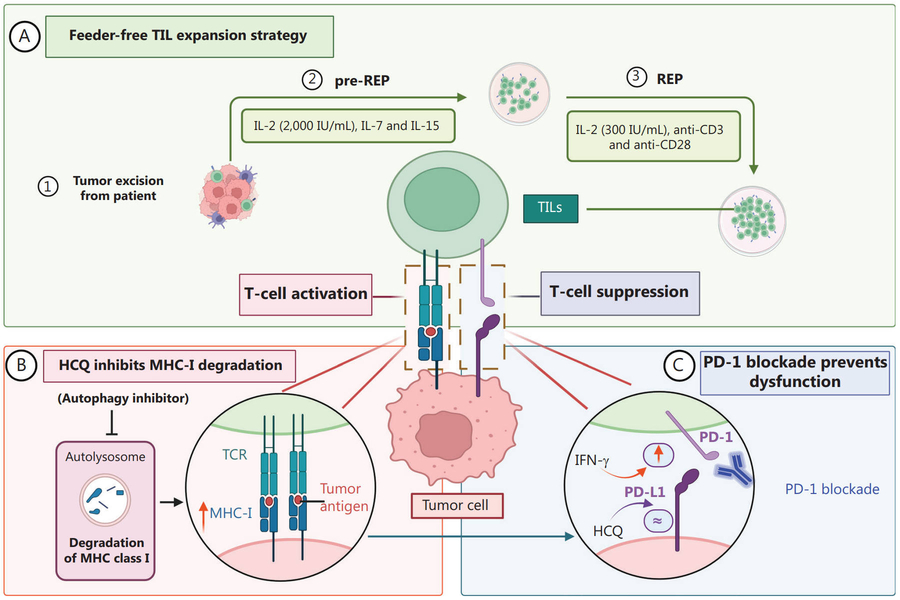
The researchers designed a two-phase expansion protocol that eliminates feeder cells entirely. During the initial pre-rapid expansion protocol (pre-REP), TILs were cultured with low-concentration IL-2 (2,000 IU/mL) supplemented with IL-7 and IL-15. The subsequent rapid expansion protocol (REP) usedaneven lowerconcentration ofIL-2 (300 IU/mL) alongside CD3/CD28 co-stimulation. This feeder-free system achieved expansion success ratesof at least90% across multiple tumor types, with melanoma-derived TILs expanding approximately 2,500-fold. The resulting TIL products demonstrated high purity (CD45+CD3+ cells _93%) and potent cytotoxic activity, secreting substantial interferon-gamma (IFN-γ) and exhibiting effector-to-target (E:T) ratio-dependent tumor cell killing. Notably, expanded TILs exhibited features consistent with a less exhausted phenotype, including minimal PD-1 expression (_0.5%) and a predominantly effector memory T-cellcomposition.In a colorectal cancer PDX model, the addition of low-dose PD-1 blockade (2 mg/kg) to TIL therapy significantly reduced tumor volume compared with the control group (P = 0.002) and maintained higher body weights, while completely preventing tumor ulceration—a complication observed in TIL-only and control groups. The researchers also explored hydroxychloroquine (HCQ) as an immunomodulatory agent; HCQ significantly up-regulated MHC-I expression on tumor cells in vitro without affecting programmed death-ligand 1 (PD-L1) levels or impairing TIL proliferation, and enhanced early-phase T-cell receptor-engineered T cell (TCR-T cell)-mediated tumor-killing.
“Our goal was to eliminate TIL therapy’s dependency on high-dose IL-2, which has been a major barrier to broader clinical use,” the authors said. “By creating a feeder-free system with carefully calibrated cytokine support, we’ve shown that we can generate functional, less exhausted TILs from multiple tumor types. The addition of low-dose PD-1 blockade not only boosted anti-tumor efficacy but also improved treatment tolerability, as mice in the combination group maintained better health and avoided the ulceration observed with TILs alone. While HCQ showed intriguing immunomodulatory effects, its in vivo benefit was limited in this small study. We believe this feeder-free, IL-2-sparing strategy has real potential to make TIL therapy safer and more widely available for patients with solid tumors.”
The findings carry significant implications for the future of TIL-based immunotherapy. By eliminating feeder cells and reducing IL-2 doses, the protocol simplifies manufacturing and may lower production costs, potentially making TIL therapy more affordable and accessible beyond specialized treatment centers. The demonstration that low-dose PD-1 blockade may serve as an alternative to post-infusion high-dose IL-2 support addresses a major safety concern, as PD-1 inhibitors are already widely used in clinical practice with well-characterized safety profiles. This IL-2-independent strategy has already been explored in a clinical trial for advanced gynecologic cancers with early favorable safety signals. Future research will need to validate these findings in larger animal models and across diverse tumor types, and investigate the underlying mechanisms of TIL persistence and tumor microenvironment modulation. If confirmed in clinical studies, this approach could expand the reach of TIL therapy to a broader population of patients with solid tumors who currently have limited treatment options.
References
DOI
10.20892/j.issn.2095-3941.2025.0441
Original Source URL
https://doi.org/10.20892/j.issn.2095-3941.2025.0441
Funding information
This study was supported by the Science and Technology Innovation Action Plan of the Science and Technology Commission of Shanghai Municipality (STCSM) (Grant No. 22XD1432200).
About Cancer Biology & Medicine
Cancer Biology & Medicine is a peer-reviewed open-access journal sponsored by China Anti-cancer Association (CACA) and Tianjin Medical University Cancer Institute & Hospital. The journal monthly provides innovative and significant information on biological basis of cancer, cancer microenvironment, translational cancer research, and all aspects of clinical cancer research. The journal also publishes significant perspectives on indigenous cancer types in China. The journal is indexed in SCOPUS, MEDLINE and SCI (IF 12.4), with all full texts freely visible to clinicians and researchers all over the world (http://www.ncbi.nlm.nih.gov/pmc/journals/2000/).
Chuanlink Innovations, where revolutionary ideas meet their true potential. Our name, rooted in the essence of transmission and connection, reflects our commitment to fostering innovation and facilitating the journey of ideas from inception to realization.
Related Link:
http://chuanlink-innovations.com
—
For the original version of this press release, please visit 24-7PressRelease.com here
Legal Disclaimer: The content on this page is syndicated from independent third-party providers. Kyrion Media makes no warranties or representations regarding the accuracy, completeness, legality, or reliability of the information, including text, images, videos, or licenses. If you are affiliated with this content or have any complaints, copyright concerns, or requests for removal, please contact us at retract@kyrionmedia.com with the specific URL of the content in question. We will review and address valid requests promptly.