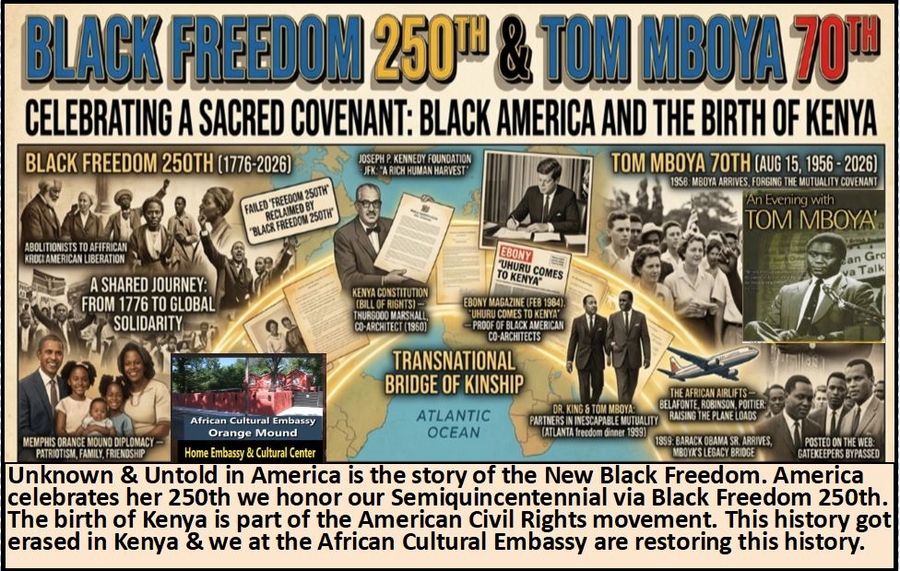
MEMPHIS, TN, August 15, 2026 /24-7PressRelease/ — Those who read this story I call upon the moral character of those who have a conscience for justice. This story is not political — it is moral, ancestral, and historical. This story is titled: “Black Freedom 250th & Tom Mboya 70th: A New Era of African–American and Kenyan Cultural Unity.” The subtitle reads: “Celebrating the Sacred Covenant and Birth of Kenya.”
Those who read this story please understand that Kenya President Jomo Kenyatta after the death of of Tom Mboya in 1969 used his function and authority to erase the history of Tom Mboya. We use objective American sources to challenge the erasure in Kenya.
Click here to read the March 7, 1960 issue of Time Magazine whereas Kenyan Tom Mboya is on the cover. This story proves that it was January/February of 1960 whereas Tom Mboya and Black Supreme Court Justice Thurgood Marshall negotiated the birth of Kenya as an independent Black Nation. Jomo Kenyatta was in prison and not released until August of 1961. Tom Mboya speaks to 20,000 Kenyans. Tom Mboya was murdered July 5, 1969 and Jomo Kenyatta erased Tom Mboya and America’s role in the birth of Kenya out of History.
Those who read this story must learn about Memphis White Supremacy, Racism and Black on Black Racism. My name is Anthony “Amp” Elmore. I am a 5-time World “Karate/Kickboxing Champion.” Whereas President Trump held the “UFC Freedom 250” mixed martial arts event on the South Lawn on the White House Sunday June 14, 2026 Anthony “Amp” Elmore promoted the 1st Kickboxing event in Memphis 47 years earlier in Memphis in 1979. Elmore introduced Kickboxing in Kenya held at the Nairobi, city hall in March of 1994 32 years before President Trump Whitehouse “UFC Freedom 250.”
Anthony “Amp” Elmore is the 1st Kickboxer in American history to be sponsored by a major American corporation “Coors Beer” in 1982 whereas Anthony “Amp” Elmore was the 1st to bring E.S.P.N. to Memphis in 1981.
While President Trump promoted “Freedom 250” whereas America is celebrating “America 250th” until the end of 2026. August 15, 2026 is the scheduled date of “Black Freedom 25OTH.”
Click here to view the story and website of “Black Freedom 250th.
Black Freedom 250th Celebration is historic in that it is the only African American Semiquincentennial celebration in America. Anthony “Amp” Elmore notes that our celebration of America’s “Semiquincentennial” is via “Education, Diversity and Democracy.” The mission of “Black Freedom 250th” mission is to deliver the definitive, un-sanitized, and comprehensive historical record of African-descended liberation across the entire American continent.
True democracy requires narrative honesty. While mainstream, corporate institutions restrict their focus to a 1776 Eurocentric sandbox, Black Freedom 250th expands the map. We define America not as a single, isolated country bound by politically gerrymandered lines, but as a vast, interconnected continent. Our platform stands as the global epic of transnational unity, historical preservation, and systemic emancipation, powered by the core pillars of Education, Diversity, and Democracy.
Black Freedom 250th is not like President Trump’s single day event Black Freedom 250th is an Education, Diversity and Democracy Initiative that is an education course.
In concert with America’s 250th celebration is August 15, 2026 which marks the 70th year of African Pan-Africanist Tom Mboya who came to America on his 26th birthday August 15, 1956.
This video background written tells the story of Anthony “Amp” Elmore who followed Black Revolutionary leader Malcolm who encouraged Black Youth to honor Jomo Kenyatta and the Mau Mau as heroes and Freedom fighters. In October of 1964 Malcolm X traveled to meet Jomo Kenyatta.
In the video Anthony “Amp” Elmore systematically detail how Black America invested directly into the foundation of modern Kenya. Through the leadership of 26-year-old Kenyan trade unionist Tom Mboya and the American Committee on Africa (ACOA), Mboya forged an unprecedented alliance with key figures of the U.S. Civil Rights Movement. Leaders like A. Philip Randolph of the Brotherhood of Sleeping Car Porters provided early financial backing (including a $35,000 check from the AFL-CIO to build Kenya’s union hall).
While figures such as Dr. Martin Luther King Jr., Harry Belafonte, Jackie Robinson, and Sidney Poitier lent their moral authority, influence, and personal capital to establish the African American Students Foundation (AASF) and the historic 1959–1963 Airlifts. Black Americans—giving single dollars out of their own pockets during the height of Jim Crow—helped fund the airlifts that brought nearly 800 East Africans (including Barack Obama Sr.) to American universities.
Furthermore, Civil Rights attorney and future Supreme Court Justice Thurgood Marshall personally traveled to London to draft Kenya’s original Bill of Rights and anti-colonial constitution.
This massive human, legal, and financial effort meant that Black America acted as the true midwife to Kenya’s independence, establishing what can only be described as a foundational “birthright” and “sweat equity” in the birth of the nation.
However, the deep betrayal occurred following Kenya’s independence in December 1963 and reached its tragic turning point on July 5, 1969, when Tom Mboya was assassinated by a gunman in broad daylight on the streets of Nairobi. Following Mboya’s death, the political establishment under President Jomo Kenyatta executed a calculated, state-sanctioned campaign to suppress Mboya’s legacy and erase the role of Black America from Kenya’s official history.
To consolidate power and prevent Mboya’s vision of multi-ethnic, democratic Pan-Africanism from challenging Kenyatta’s ruling elite, the Kenyan government systematically excised the Civil Rights Movement from national school curricula, historical monuments, and civic memory.
Despite Civil Rights leaders traveling to Kenya to celebrate its independence, no highways, expressways, or major national institutions were named in honor of Jackie Robinson, Thurgood Marshall, A. Philip Randolph, or the Black American donors who funded Kenya’s educated founding civil service.
This erasure went far beyond silencing one man’s legacy; it intentionally broke the diplomatic, cultural, and spiritual bridge connecting Black Americans to East Africa. By scrubbing Mboya’s story and replacing it with a narrative centered heavily on Eurocentric safari tourism and post-colonial elite rule.
The Government of Kenya effectively robbed Black Americans of their acknowledged place in Kenyan history. This suppression obscured the historical reality that the 1960 Kennedy-Mboya connection—which secured $100,000 from the Kennedy Foundation for student transport—swung key Black American voter endorsements (like Harry Belafonte’s) and delivered JFK’s narrow presidential victory, ultimately laying the groundwork for Barack Obama Jr. to become the first Black President of the United States.
Anthony “Amp” Elmore call out in the video to establish a Tom Mboya / Dr. Martin Luther King Jr. Cultural and Educational Center in Nairobi** serves as an essential proposal to rectify this historic wrong. It challenges the Kenyan government and the international community to restore the erased history, honor the sacred bond forged between Mboya and the Civil Rights Movement, and reclaim the rightful birthright of Black Americans as co-architects of Kenya’s freedom.
President Theodore Roosevelt’s 1909 East African safari was arguably the first modern, globally synchronized mass media event, engineered to captivate millions across print, photography, and film. Fresh out of the White House, Roosevelt leveraged his celebrity to orchestrate a year-long expedition sponsored by the Smithsonian Institution, transforming big-game hunting into a daily media spectacle.
Journalists tracked his movements via telegraph, newspapers published serialized dispatches of his exploits, and his bestselling 1910 book African Game Trails saturated the American market. Crucially, the expedition was documented by a dedicated crew of photographers and early motion-picture filmmakers. Moving-picture reels of “Teddy in Africa” were shipped back to Western nickelodeons and theaters, allowing everyday citizens to visually experience the African wilderness for the first time on screen, establishing East Africa—and Kenya in particular—as the ultimate grand backdrop for Western adventure, exoticism, and colonial dominance.
This massive cultural wave directly fueled the imagination of author Edgar Rice Burroughs, laying the groundwork for the creation of Tarzan of the Apes in 1912. Burroughs, who had never stepped foot on the African continent, drew heavily from the sensationalized press reports, wildlife photographs, and popular narratives generated by Roosevelt’s headline-grabbing expedition.
The public’s voracious appetite for African jungle lore, created by the media frenzy around Roosevelt, meant that the market was primed for a story about a wild, untamed frontier governed by a heroic white protagonist. By codifying the tropes of the bulletproof explorer navigating a dangerous, exotic paradise, Roosevelt’s safari provided both the ideological template and the commercial audience for Burroughs’ pulp phenomenon, cementing the “Tarzan narrative” in Western pop culture for generations to come.
Tarzan of the Apes was first published in a pulp magazine in 1912 and released as a novel in 1enduring Western trope: Africa as an untamed, dangerous jungle requiring a white hero to master it914. Written by Edgar Rice Burroughs (who had never visited Africa), the book established an . This media framework heavily shaped Western expectations of East Africa for a century.
While the word Safari is originally a Swahili word meaning “journey” (derived from the Arabic *safar*), American writer Ernest Hemingway is largely credited with popularizing it in the English language and making it synonymous with big-game hunting.
Through works like The Short Happy Life of Francis Macomber (1936) and Green Hills of Africa (1935), Hemingway romanticized high-end East African hunting trips, codifying the imagery of luxury tented camps, khaki gear, and wealthy Westerners traversing the bush.
When Kenya gained independence in 1963, Kenya President Jomo Kenyatta and the ruling elite chose a path of state capitalism rather than radical restructuring. The Kenyan government expanded it.
Luxury lodge networks, game reserves, and coastal resorts were maintained to attract Western foreign exchange. The Kenyatta family and high-ranking political insiders acquired vast swathes of land and heavy stakes in the hotel, tour, and hospitality sectors. The black ruling class effectively partnered with white-owned travel agencies and international investors to preserve a two-tiered system: luxury experiences for wealthy Westerners, maintained by local labor.
Jomo Kenyatta rejected African Americans, and Tom Mboya and what was called Black American Radicalism. Preserving the Status Quo Jomo Kenyatta and the Kenyan political elite depended on Western capital, European tourism, and diplomatic backing from Britain and the U.S.
America offer the threat of Civil Rights Politics. Black Americans visiting or emigrating in the 1960s and 70s often brought radical civil rights, Pan-Africanist, or anti-imperialist views. To a conservative Kenyan establishment focused on catering to rich white tourists and foreign investors, Black American demands for systemic equality and anti-colonial critique were seen as politically destabilizing.
Tom Mboya was a brilliant, charismatic Kenyan labor leader and Minister for Economic Planning. He was the key architect of the famous Kenya Airlifts of the late 1950s/early 1960s (supported by John F. Kennedy and Black American figures like Harry Belafonte), which brought young East Africans—including Barack Obama Sr.—to study in American universities.
Mboya was viewed as a progressive, pan-African bridge-builder who envisioned a more modern, meritocratic, and internationally connected Kenya. His assassination on July 5, 1969, crushed the major political alternative to the entrenched political elite headed by Jomo Kenyatta.
After Mboya’s death Kenya President Jomo Kenyatta consolidated power within a smaller, highly conservative circle surrounding whereas this ensured that Kenya’s President Jomo Kenyatta economic trajectory—including its reliance on elite white tourism and Western alignment—remained fully intact.
The Kisumu Massacre of October 25, 1969, represents a pivotal turning point in Kenya’s history, marking the moment when the post-independence state codified authoritarian suppression and deep political marginalization. Tensions were already at a boiling point following the assassination of Tom Mboya just four months earlier, which had deeply alienated the Luo community.
When President Jomo Kenyatta traveled to Kisumu—the political stronghold of his chief rival, Jaramogi Oginga Odinga—to open a new hospital, a hostile crowd confronted him over Mboya’s murder and political exclusion. Following a heated verbal exchange between Kenyatta and Odinga, presidential guards and police opened fire into the crowd, killing dozens of men, women, and children and injuring many more. In the immediate aftermath, the Kenyatta government banned the main opposition party, the Kenya People’s Union (KPU), arrested Odinga and his allies, and effectively turned Kenya into a de facto one-party state. This established a culture of state enforcement where silence became a mechanism for survival, forcing intellectuals, civil servants, and ordinary citizens to suppress political dissent or face detention, violence, and economic ruin.
The legacy of October 1969 continues to reverberate through modern Kenya, as the state apparatus used the tragedy to enforce economic and social isolation on entire regions, establishing a precedent of state-sanctioned violence during periods of political contestation. Decades of state censorship erased the Kisumu Massacre from official school textbooks, creating a silence so pervasive that even global political figures were affected.
Barack Obama Sr., a Harvard trained economist who had returned to Kenya with an education from the United States, was himself systematically sidelined, blacklisted from government roles, and emotionally broken by the Kenyatta regime for speaking out against corruption and economic inequality.
When President Barack Obama Jr. later emerged on the global stage, his public posture toward Kenya remained carefully diplomatic, largely navigating around the specific state crimes that destroyed his father’s career and targeted the political generation of 1969. Today, the silence enforced in 1969 remains visible in the ongoing struggle against state impunity, where memory and historical truth are still actively suppressed to protect the continuity of elite political control.
Following the death of Jomo Kenyatta in 1978, President Daniel Arap Moi systematically escalated state repression, establishing an authoritarian apparatus that operated beneath a carefully maintained façade of East African stability. While Western powers initially viewed Kenya as a reliable, anti-communist partner in the region, Moi’s regime enforced absolute loyalty through single-party rule, state surveillance, and brutal violence against political dissidents.
At the center of this apparatus were the sub terranean cells of Nyayo House in Nairobi, where students, professors, journalists, and activists were subjected to systematic interrogation and severe torture by the state’s Special Branch. As domestic unrest grew alongside international outrage over human rights abuses, it was ultimately pressure from the United States and foreign aid donors in 1991—threatening to freeze financial assistance—that forced the Moi administration to repeal Section 2A of the constitution and restore multi-party democracy.
Within this climate of state-sanctioned fear, Female Professor Wangari Maathai emerged as one of the regime’s most formidable opponents, spearheading a grassroots struggle for environmental preservation and civil rights. Educated in the United States as part of the early student airlifts, Maathai drew the relentless wrath of the government for defending public spaces like Uhuru Park and Karura Forest against elite land-grabbing.
During a pivotal 1992 protest led by mothers demanding the release of political prisoners detained and tortured in Nyayo House, riot police violently attacked the peaceful gathering with batons and tear gas. In response, several elderly mothers stripped off their clothes in an extraordinary act of cultural resistance. In Kikuyu tradition, exposing a mother’s or grandmother’s body to younger men levels a profound spiritual curse and moral shame; paralyzed by this taboo, the armed soldiers shielding their eyes were forced to retreat.
This non-violent confrontation exposed the regime’s brutality on the global stage, severely undermining Moi’s authority and solidifying Maathai’s legacy, which was later recognized when she became the first African woman to win the Nobel Peace Prize in 2004.
In 1990 Memphis five time world Kickboxing champion made world filmmaking history in Kenya whereas Anthony “Amp” Elmore 1998 film “The Contemporary Gladiator” Premiered in Kenya in 1990. Unknown and untold “The Contemporary Gladiator” is not only the 1st “kickboxing Movie in World film History” The Contemporary Gladiator is the 1st Industrial Trade deal between an African Government and an African/American business. Elmore was named an African Ambassador by Kenya President Daniel Arap Moi in 1992.
Click here to see a short trailer of the 1988 movie “The Contemporary Gladiator.”
Anthony “Amp” Elmore introduced Kickboxing to Kenya at the Nairobi City hall in 1994. Click here to view the 1994 video titled: Kickboxing in Kenya. Mystically the video shows Anthony “Amp” Elmore at the New Stanley Hotel in 1994. It was in 1964 whereas John Lewis met Malcolm X at the New Stanley Hotel, whereas 30 years later Anthony “Amp” Elmore is at the New Stanley hotel.
The most important aspect of Kenya and its betrayal to Black America is its erasure of Black History whereas Kenya’s erasure denies both Kenyans and African/Americans and Americans is its “Birth Right.” Jomo Kenyatta is not the sole father of Kenya.
Click here to view the website: “Birth of Kenya Part of Civil Rights Movement .com
Kenya is more than just an African Country, Kenya is the returning point for Black America to connect to its African heritage. Let us explain why Kenya is the returning point for Black Americans to start learning their African heritage. While the birth of humanity is at the Ethiopian/Kenya border more important for Black Americans is the fact that Kenya holds an over 100 years of “Tourist Infrastructure.” Kenya’s Tourism is designed to accommodate the very best in world tourism.
In regards to entertainment Kenya represents a space for absolute Black culture whereas Kenyans have engaged with African/Americans prior to it becoming an Independent nation whereas there are place in Kenya that mirrors Black America.
Click here to see the Anthony “Amp” Elmore 1994 video titled: African American on a Kenya Safari
There is no one in the history of Kenya who can document African/Americans on a Kenya Safari prior than Anthony “Amp” Elmore who took groups to Kenya for over a decade. Anthony “Amp” Elmore notes that unlike White people most African/Americans are not only uninterested and unexcited about in animal Safaris many African/Americas are terrified of sleeping at a Safari camp.
There is a cultural divide while many Whites love experiencing nature most African/American love entertainment as opposed to the quite of nature. African/Americans enjoy meeting people and experience culture as opposed to animal.
The African Cultural Diplomat Exchange Network represents an evolution in global education and grassroots pan-African connection, transforming traditional pen-pal programs into a real-time, interactive diplomatic bridge for the 21st century. Spearheaded by Memphis filmmaker Anthony “Amp” Elmore—working in ongoing collaboration with Erick Were—this initiative directly links students at Cherokee Elementary School in Memphis, Tennessee, with their peers at Arya Primary School in Kisumu, Kenya
Please click here to see the video produced by Erick Were they wanted to name their class after Anthony “Amp” Elmore whereas Elmore suggested they name the School after Memphis Congressman Steve Cohen.
At its core, this network builds upon deep historical and political ties between Memphis and Kisumu, carrying forward the diplomatic spirit ignited when Kisumu Governor Professor Peter Anyang’ Nyong’o visited Memphis in 2019 to honor the legacy of Tom Mboya.
Governor Nyongo invited Anthony “Amp” Elmore Sr. and Anthony “Amp” Elmore Jr. to Kisumu Kenya as cultural Ambassadors in 2024. In 2019 Kisumu Governor Peter Nyong’o visited Memphis and ate Kenya food in Orange Mound at Anthony “Amp” Elmore’s home.
See first hand Kenyan Dignitaries who came to Memphis whereas we honored Dr. Martin Luther King Jr. and Kenya’s Tom Mboya. We practice “Cultural Diplomacy.”
We are working via cross-cultural celebrations—such as introducing Kenyan students to Kwanzaa and co-hosting international Black History Month programming—the exchange bridges the historic African American cultural tradition directly with East Africa harnessing modern streaming technology and mobile connectivity, the network proves that grassroots diplomacy no longer requires vast corporate budgets, empowering the next generation of Black youth on both sides of the Atlantic to shape their shared future together.
For the reader who reads this story we mention about the “Kisumu Massacre of 1969.” The Kisumu Governor knows about the history of Jomo Kenyatta killing people in Kisumu Kenya. These horrible things are not talked about in Kenya. It is also not talked about is the fact that “Kenya’s birth is part of the American civil rights movement whereas both Kenya and America and African/Americans can benefit learning this history and building bridges.
Unknown and untold Kenya provides Black America a historical connection to Africa whereas when it comes to Africa Black American are connected to Slavery and James Town in 1609. In regards to Kenya in the case of Anthony “Amp” Elmore he explains that when I go to Kenya I feel the spirit of my President John F. Kennedy whose Kennedy foundation gave $100,000 for air fights of Kenya Students to study in America and the Kennedy Founder gave another 100,000 to support students in America.
Elmore explains that it is heart warming to know that Dr. Martin Luther King’s Church gave money to support a Kenyan student and just about every leader in the America civil rights movement both Blacks and Whites assisted in the birth of Kenya.
Dr. Martin Luther King said: “Silence is Betrayal.” From the African Cultural Embassy in Orange Mound we celebrate “Black Freedom 250th” and Tom Mboya 70th whereas Anthony “Amp” Elmore makes “The African Cultural Embassy (The Tom Mboya Legacy District.)”
If anyone asks what the August 15, 2026 Celebration in Orange Mound is all about we can say its about the new diplomatic practice called “Kinship Diplomacy.”
Click here to visit the website titled: Charter of Kinship. com This is a new diplomacy created via the African Cultural Embassy in Orange Mound. We note that we African/Americans and Kenyan are “Kin” and family and we solidify our relationship via signing “The Charter of Kinship.”
Our Journey and Mission
Orange Mound, established as the first community in America built for Blacks by Blacks, has a rich history often overshadowed by negative stereotypes. Mainstream media and societal biases have painted Orange Mound as a “ghetto,” contributing to a 30% decline in property values while surrounding communities have prospered. The Orange Mound News Network was created to counter this narrative and highlight the true spirit and resilience of our community.
Anthony Amp Elmore,
a five-time world karate kickboxing champion, filmmaker, and community activist, has been a beacon of change in Orange Mound. With over five decades of community service, Elmore has dedicated his life to uplifting Orange Mound. From becoming a homeowner at 19, establishing businesses, to founding the Proud Black Buddhist World Association, Elmore’s contributions have been immense.
Connecting Communities Through Culture and History
Elmore’s journey in cultural diplomacy began when he was invited to Kisumu, Kenya, by Governor Anyang’ Nyong’o to attend FESTAC, the largest African and Black Art festival in the world. It was here that Elmore’s vision for a deeper connection between Africans and African Americans took root. During his visit, he engaged with students at ARYA Primary School, performed a song about Kenya’s founding father Tom Mboya, and proposed a pen pal program that evolved into a robust educational and cultural exchange.
Our journey in African Cultural Diplomacy began in 1990
when the Orange Mound Memphis-produced movie “The Contemporary Gladiator” premiered in Kenya. This marked a significant milestone in Elmore’s mission to foster cultural exchange and understanding. The film’s premiere in Kenya not only showcased Elmore’s work but also solidified his role as a cultural diplomat.
—
For the original version of this press release, please visit 24-7PressRelease.com here
Legal Disclaimer: The content on this page is syndicated from independent third-party providers. Kyrion Media makes no warranties or representations regarding the accuracy, completeness, legality, or reliability of the information, including text, images, videos, or licenses. If you are affiliated with this content or have any complaints, copyright concerns, or requests for removal, please contact us at retract@kyrionmedia.com with the specific URL of the content in question. We will review and address valid requests promptly.