KNOXVILLE, TN, July 08, 2026 /24-7PressRelease/ — Accurate sunlight data is becoming essential for the clean-energy transition, but tracking how much solar radiation reaches Earth’s surface remains difficult when clouds, aerosols, and atmospheric changes shift rapidly. A new transfer learning framework now enables China’s Fengyun-4A (FY-4A) geostationary satellite to estimate surface solar radiation (SSR) and its global, direct, and diffuse components with high accuracy. By adapting knowledge from the Himawari-8-based Cloud, Atmospheric Radiation and Renewal Energy Application (CARE) product, the model reduces dependence on auxiliary meteorological datasets. The resulting FY-4A radiation estimates provide a stronger data foundation for solar power forecasting, climate research, land-surface modeling, and sustainable energy planning.
Surface solar radiation controls Earth’s energy balance, hydrological cycles, ecosystem processes, and the performance of solar photovoltaic (PV) and concentrating solar power systems. Ground-based radiometric networks offer the most reliable observations, but their stations are sparse and unevenly distributed, especially across oceans and developing regions. Reanalysis products provide broad coverage but may lose accuracy because of coarse resolution and simplified cloud–aerosol–radiation interactions. Satellite observations can fill this gap, yet many existing algorithms are sensor-specific, and most products focus mainly on global radiation rather than separately estimating direct and diffuse components. Based on these challenges, a deeper investigation into transferable, high-resolution solar radiation retrieval from Chinese geostationary satellites is needed.
Researchers from the Aerospace Information Research Institute, Chinese Academy of Sciences; Sichuan University of Science and Engineering; and the Institute of Atmospheric Physics, Chinese Academy of Sciences, reported (DOI: 10.34133/remotesensing.1044) the study in Journal of Remote Sensing on April 29, 2026. The article presents a new satellite-based method for retrieving global, direct, and diffuse solar radiation from FY-4A. The work targets a key operational problem: how to deliver accurate sunlight estimates at high spatiotemporal resolution without relying heavily on dense ground observations or auxiliary atmospheric datasets.
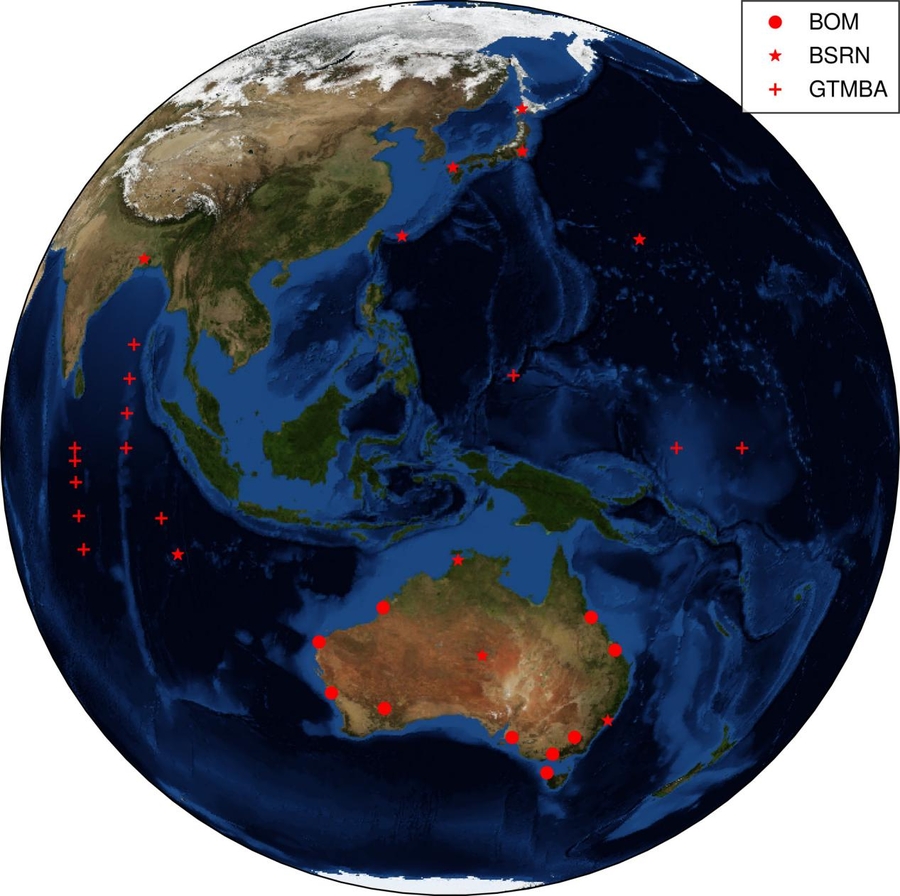
The study’s key advance is a transfer learning strategy that carries radiative knowledge from Himawari-8 to FY-4A. The team first developed a deep neural network (DNN) model using Himawari-8 Level 1 (L1) observations and the Cloud, Atmospheric Radiation and Renewal Energy Application (CARE) radiation product, then fine-tuned the pretrained model with FY-4A L1 data. The model uses top-of-atmosphere (TOA) reflectance and solar–satellite geometry as dynamic inputs, while Bayesian optimization automatically selects key hyperparameters to improve generalization and efficiency. Validation was performed using 33 ground stations from the Baseline Surface Radiation Network (BSRN), Bureau of Meteorology (BOM), and Global Tropical Moored Buoy Array (GTMBA) during 2018–2020. At representative BSRN sites, FY-4A achieved instantaneous root mean square errors (RMSEs) of 102.2, 117.5, and 83.1 W m⁻² for global, direct, and diffuse radiation, respectively. At the daily mean scale, the RMSEs dropped to 28.5, 30.1, and 22.6 W m⁻², showing strong performance across different temporal scales.
The authors said the study shows how knowledge from a mature satellite product can be transferred to another platform to build new operational capability. They said the framework allows FY-4A to estimate not only total sunlight but also the direct and diffuse components that determine how solar energy systems perform under clear, cloudy, and hazy conditions. They also emphasized that reducing reliance on auxiliary meteorological data makes the method more practical for near-real-time monitoring. In their view, the approach turns China’s geostationary satellite observations into a more powerful resource for energy and climate applications.
The new FY-4A radiation product could help improve PV site assessment, power forecasting, grid management, climate modeling, and land-surface simulations. Direct radiation is especially important for concentrating solar power, while diffuse radiation affects PV output under cloudy or aerosol-rich skies. By resolving these components separately, the framework offers more actionable information than global radiation alone. The study also demonstrates that transfer learning can help overcome sensor differences and limited ground training data. Looking ahead, the same strategy could be extended to other Chinese geostationary satellites, including Fengyun-4B (FY-4B), supporting more reliable solar-energy monitoring across East Asia and beyond.
References
DOI
10.34133/remotesensing.1044
Original Source URL
https://spj.science.org/doi/10.34133/remotesensing.1044
Funding information
This work was supported by the National Natural Science Foundation of China (Nos. 42025504, 42405145, and 42430604), the Natural Science Foundation of Sichuan Province (No. 2024NSFSC0770), the Tianfu Yongxing Laboratory Organized Research Project Funding (No. 2024KIGG18), and the Opening Fund of Artificial Intelligence Key Laboratory of Sichuan Province (No. 2024RYY03).
About Journal of Remote Sensing
The Journal of Remote Sensing, an online-only Open Access journal published in association with AIR-CAS, promotes the theory, science, and technology of remote sensing, as well as interdisciplinary research within earth and information science..
Chuanlink Innovations, where revolutionary ideas meet their true potential. Our name, rooted in the essence of transmission and connection, reflects our commitment to fostering innovation and facilitating the journey of ideas from inception to realization.
Related Link:
http://chuanlink-innovations.com
—
For the original version of this press release, please visit 24-7PressRelease.com here
Legal Disclaimer: The content on this page is syndicated from independent third-party providers. Kyrion Media makes no warranties or representations regarding the accuracy, completeness, legality, or reliability of the information, including text, images, videos, or licenses. If you are affiliated with this content or have any complaints, copyright concerns, or requests for removal, please contact us at retract@kyrionmedia.com with the specific URL of the content in question. We will review and address valid requests promptly.